
Welcome to Texas, where you work hard, sleep peacefully and everything is bigger! In this place of so many wide roads leading to opportunities, one of the first things you'll want to do is hop in your car and hit the road. Knowing the laws and customs of the roads in Texas can make your trip more pleasant and help you reach your destination.
Documents Needed to Drive in Texas
To play it safe when driving in Texas, the most important thing is to follow the law so that your rights are protected at every turn of the road. This involves having your valid driver's license, the registration of the vehicle you will be driving, and the vehicle's insurance.
Keep copies of the following documents in your car whenever you are going to drive:
- Vehicle registration
- Valid driver's license
- Vehicle insurance
Register Your Vehicle
When moving to Texas, you will have 30 days to register your vehicle. After the deadline, you could be exposed to larger fines if you are stopped on the road. Check with the Texas Department of Motor Vehicles to find out the current requirements and fees for registering your vehicle in Texas.
Steps to register your vehicle in Texas 🔗
- Get auto insurance that is approved by the Texas Department of Insurance. If you get insurance from a provider that isn't registered with the state, they may not pay for your coverage at the time you need it.
- Obtain a Vehicle Inspection Certificate. As of 2025, Texas does not require inspection for most non-commercial vehicles. However, some counties still require an emissions test as part of the inspection. To obtain a certificate of inspection you must take your car to an authorized inspection station. You can find an authorized station on the Texas Department of Public Safety's Inspection Station Locator. Make sure you get your car insurance before you go in for the inspection, because the inspection station will ask you for proof of insurance. You can show them the printed document or an digital insurance card available in some insurance applications for smart phones. After completing a satisfactory inspection, you will be given proof of inspection and your car's status in TxDMV's centralized system will be updated.
- Submit a completed Vehicle Registration Application. In addition to the completed application, first-time applicants will need to show the following documents:
- Vehicle title in your name or, Vehicle Registration Receipt if you are coming from another part of the United States
- Accepted form of Government photo ID
- Proof of vehicle insurance
- Texas Vehicle Registration Fee Amount
- Submit a completed Texas Driver’s License Application 🔗. Keep in mind that getting a driver's license in Texas has its own requirements. You can read more about getting a driver's license in Texas below.
Cost of registering your vehicle in Texas
As of the date of this article, according to the official website of the Texas Department of Motor Vehicles (TxDMV), the base fee for registering a vehicle in Texas is $50.75 plus the TexasSure tax of $1. Additional fees may apply depending on your county of residence.
Rules for Getting a Driver's License in Texas
Driving in Texas requires you to have a valid license. If you have just moved, keep in mind the following legal postulates:
- 90-Day Privilege: You can only drive without a Texas license if you have a valid license from another U.S. state or territory or from a Canadian province. This privilege expires upon completion of 90 days in Texas.
- Transfer licenses: Current licenses from other U.S. states or territories and Canada may qualify for a transfer without having to take the written or driving test. You must surrender your current license to get a new Texas license.
- Check your eligibility for a driver's license in Texas. You can use online eligibility verification.
Documents You Must Submit to Get a Driver's License in Texas
- Proof of identity: If you're coming from another part of the United States and have a government photo ID like a driver's license or passport, you can show them to prove your identity. Otherwise, you must follow the instructions outlined in the approved list of identification documents.
- Proof of citizenship or legal immigration status: You must show one of the documents below, as applicable. In some cases, it may require additional verification called SAVE.
- Birth certificate or birth record issued by the appropriate State Bureau of Vital Statistics or equivalent agency of a U.S. state or local government, U.S. territory, or the District of Columbia
- U.S. passport book or passport card
- Permanent Resident Card (I-551)
- I-94 stamped “Section 208 Asylum” or “Section 207 Refugee”
- Employment Authorization Card “EAD” (I-766)
- U.S. Department of State Birth Certificate issued to foreign-born U.S. citizens (Form FS-240, DS-1350, or FS-545)
- I-551 Machine-Readable Immigrant Visa with Temporary Language and ADIT Stamp
- I-20 Nonimmigrant Students (F-1)
- Non-student documents with alien number or I-94 number
- U.S. Citizen Identification Card (I-179 or I-197)
- I-94
- U.S. Travel Document (I-327 or I-571)
- I-551 stamp in foreign passport
- U.S. Certificate of Citizenship or Certificate of Naturalization (N-550, N-560, N-561, N-570, or N-578)
- Student documents with Student Exchange and Visitor Information System (SEVIS) number
- DS-2019 Exchange Visitor Certificate (J-1)
- Proof of Texas residency: You must show two documents proving that you have lived in Texas for the past 30 days. Find the list of accepted documents to prove residency here.
- Social Security
- Impact Texas Driver Certificate: Impact Texas Driver is a one-hour online course. The certificate remains valid for 90 days.
- Texas Vehicle Registration Evidence for all your vehicles: You will have 30 days to register your vehicles. After the deadline, you could be exposed to larger fines if you are stopped on the road. Check with the Texas Department of Motor Vehicles to find out the current requirements and fees for registering your vehicle in Texas.
- Evidence of Insurance for all your vehicles
- Driver's Education Course: If you have already turned 25 years old, you are exempt. If you are 18-24 years old and are surrendering a valid out-of-state driver's license, you are also exempt from this requirement. Drivers who are not surrendering a U.S. license when applying for a Texas license or who are under 18 years of age must take the six-hour course.
The Driver's License Appointment
Take advantage of your time and resources by going prepared to get your driver's license. It is important to remember the importance of obtaining a valid license since in addition to preserving your rights in case of an accident, it will serve as a preferred method of identification in many other official procedures such as obtaining lines of credit to make purchases, and requesting services. Follow these steps so you can come prepared to get your license.
Before the appointment:
Before scheduling your appointment, find out which office you should go to based on the area where you live.
- Schedule your appointment. Although your appointment will be in person, you can reserve your space online using the Texas Scheduler portal, available in Spanish.
- Complete the application. The application is available in English and Spanish. Although it is not required, it is recommended that if possible you complete it in Spanish and then transfer the answers to the English version. This could make the login process easier.
During the appointment:
- Submit all required documents to the Licensing and Permit Specialist. See the required documents section above.
- Provide your biometric information. Your signature and fingerprints will be taken.
- Pose for your photo.
- Pay the application fee.
- Take the vision test.
- Successfully complete the driving skills tests. You will take a theory test and a practical test. Study the driving laws in Texas well before going to your appointment. There are many practice tests available online. If you need extra help with the drive test, consider hiring a certified tutor. Some driving schools are even registered to administer the theoretical and practical exams. Keep in mind that their fees are not included in the official driver's license costs and you will need to check with the driving school near you.
What to expect from Texas roads?
With approximately 696,241 km² to explore in Texas, you can imagine there are many diverse environments. Being clear about how to drive like a Texan could help you get to your destination more pleasantly.
Turning Left in Texas
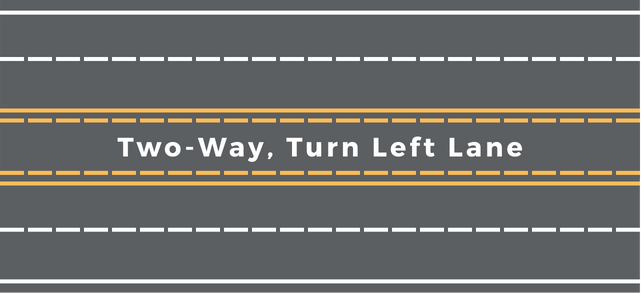
You'll notice that, in Texas, many traffic roads in both directions have a lane in the middle of both roads framed by yellow lines. This lane is provided so that you can make left turns safely. You should only use this lane when you have enough time to slow down and enter the center lane safely. The Texas Drivers Handbook describes how to turn left in detail on page 50.
No Speed Reduction Ramps
If you are coming from an area that has turn-off ramps to businesses on the side, keep in mind that Texas does not have these ramps in most places. Therefore, it is recommended to use GPS and slow down to turn towards your destination with caution and sufficient distance. If you don't have time to turn safely, consider staying on the road until the next exit where you can veer safely.
Move or Slow Down Act
Contrary to what many believe, ‘Move or Slow Down' is the law in Texas. Texas traffic laws require drivers to move lanes completely or slow down to 20 mph below the maximum speed limit when approaching certain agencies stopped on the road.
This includes when you see any of the following stopped on the road or even on the side of the road: police, law enforcement, tow trucks, utility vehicles, municipal waste trucks, emergency services, and Texas Department of Transportation vehicles.
Failure to comply with the Move or Slow Down requirement could result in a fine of up to $1,250 for a first offense and $4,000 plus jail time if you cause a serious injury.
Be Prepared in Every Season of the Year
Texans experience every season of the year. Here are some easy precautions that can help.
Precautionary Driving Reasons in Texas
- Road Winds – Especially on open field roads and highways, if you ride in a light or fairly tall vehicle, you might feel like your car is being pushed to the side. These are Texas winds, and while they're usually easy to handle, you could lose control if you're not cautious. Hold the steering wheel firmly and avoid using the autopilot when it is windy.
- Changing Weather – Summers in Texas are usually quite hot and winters have days that can vary up to 50ºF+ within 24 hours. Prepare for winter with plenty of water in your vehicle; enough to stock your car's reservation and for everyone in the car to drink if they get stranded. For winter, make sure your air conditioner is in good shape, your antifreeze stock is stocked, and pack blankets to protect you from the cold if you get stranded on the road.
- Trains, Deer, and Cattle – Not exclusive to Texas, but we know that not everyone who moves to Texas comes from a place with these dangers. If you hear warning bells when approaching a train intersection, do not speed. Stop the car and wait for the train to pass before continuing on your way. When you're in your car at night, be on the lookout for deer or cattle running onto the road, especially in fields and meadows. It is worth taking this precaution at any time of the day in rural areas.
Process After an Infraction or Accident
We hope that between these tips and the guidance of the driving test you can avoid accidents. However, we know that a mistake can be made by anyone, sometimes even unintentionally. Follow these steps after an accident or being pulled over on the road for a potential violation.
After a Crash
- Don't take blame. Avoid saying things like ‘I'm sorry'. Better, ask if they are okay or if they need medical help.
- Call the police.[AT4] A police report may help you in a legal case.
- Write down all the other driver's information including full name, address, license number, phone number, and insurance company. In addition, you must obtain the make, model, and year of the vehicle.
- Take photos. Only do this if your physical condition allows it and it can be achieved without facing danger. If you can't take photos immediately, do so at a later time or, if your medical condition prevents you from doing so, arrange for someone you trust to do it for you as soon as possible.
- Seek medical attention. Some injuries are not felt immediately; it is important to visit a healthcare professional so that they can evaluate you and identify any injuries caused by the collision.
- File a claim with your insurance company. Do not accept the agreement immediately. Some companies give offers below the value of the damages. Check the true value of your damages before accepting the insurance payment offer.
- Seek legal advice. An experienced personal injury law firm can guide you through your legal options and help you get a fair resolution and the compensation you need to recover.
After being arrested for an alleged violation
When you are arrested, three things are paramount: stay calm, remain alert and follow the instructions of the law. If you are stopped on the road:
- Assume an attitude of seriousness, courtesy and collaboration. Do not confront the officer with your words.
- Ask why you have been detained. Usually the officer will tell you why he or she has pulled you over, but if he or she does not, you can ask why.
- Provide the license and vehicle registration only when requested. It is best to always have these documents within reach. If you must reach another part of the car to grab them, tell the police officer first to avoid confusion or that you may think you are reaching for a gun.
- Save your appointment well and consider hiring a defense attorney. The officer may give you a summons to appear before the judge. Keep an eye on your email and mail for any changes or requests that may be sent by the appropriate court. If you wish to hire a defense attorney, contact an experienced attorney as soon as possible and keep him or her informed of any court communications.
- Arrive early for your court date. Check ahead of time to which court you are due to appear so that you can arrive early. If you have any evidence to show that you are not at fault for the violation, you should take it with you.
- Costs associated with an infraction. If you are found to have committed a violation, you will have to pay a fine. The amount of the fine will depend on the court hearing your case, the applicable laws, and the judge's decision. In some cases, if you can't pay right away, you may be able to apply for a payment plan or community service arrangement. It is advisable that you consult with a defense attorney and check local options.
Drive Like a Texan, Be Protected Like a Texan
We hope this information will help you get started on your Texas road journey. Our goal is to protect your rights and that starts with knowing them.
If you find yourself in a situation that needs legal representation after an accident or violation, know that we are here to serve you at The Carlson Law Firm. We care. We can help.